Conspiracy Theorists Rejoice!
In the mid-1950s, a little booklet began circulating in America. It claims to lay out a way to conquer a country without firing a shot: flood its culture with chaos, break up its families, turn its young people, rewrite its textbooks, take over its mental-health system, and wipe out any healer who actually helps. When it names the healers who actually help, Dianetics is on the list. Here’s the playbook in its own words, page by page, and what the record shows happened after officials got their hands on it.
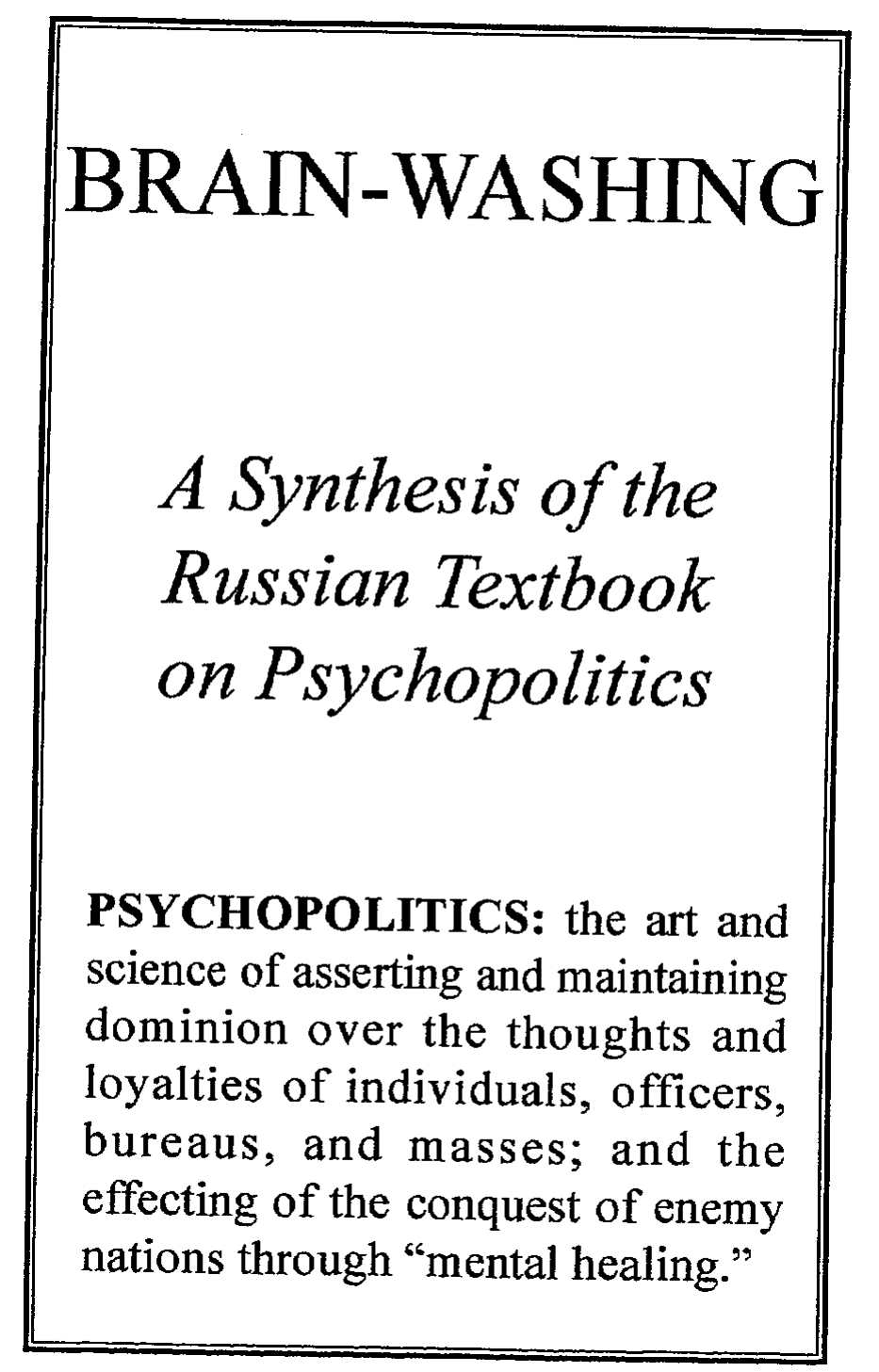 Cover, Brain-Washing: A Synthesis of the Russian Textbook on Psychopolitics (undated AFN Books reprint). Scan: Internet Archive, item goff_Brain_washing.
The paper trail
Before we open the booklet, here’s where it turns up in the official record. The three entries below are printed in the bound Congressional Record, the permanent record of the proceedings of Congress. The page scans come from the Government Publishing Office’s govinfo site. I’ve linked each page so you can read it yourself.
- June 13, 1957: Rep. Usher L. Burdick (R-N.D.). In an extension of remarks titled “Beware of Psychiatrists,” Burdick told the House: “My next Extension of Remarks will include the speech of Beria, who addressed a group of American students at Lenin University in Russia” (103 Cong. Rec. A4642–A4643). His next one, “Communist Brainwashing for Americans,” opens: “Mr. Speaker, to apprise the people of this country just what the Communist practice was and probably still is in regard to the treatment of so-called mentally sick persons, I have decided to reprint the entire speech made by Communist Beria to a class of American students at Lenin University.” Then comes “An Address by Beria,” the same address that opens the booklet (pp. 3–4) (103 Cong. Rec. A4644–A4645). Burdick doesn’t say where he got his copy.
- August 12, 1958: Rep. Edgar W. Hiestand (R-Calif.). Under the heading “Psychopolitics, the Basic Communist Tactic,” Hiestand inserted “two additional articles by that great patriot, George Todt, of the North Hollywood, Calif., Valley Times,” saying “These articles outline the basic Communist tactic, psychopolitics, and should awaken all America to this grave threat.” Todt’s column of July 30, 1958 names its source: the Beria address “as reported by ex-Communist Kenneth Goff in his book Brainwashing” (104 Cong. Rec. A7356–A7357).
- January 20, 1959: Hiestand again. Under “Soviet Psychopolitics,” he inserted “articles III and IV of George Todt’s current series on ‘Psychopolitics.’” Todt quotes Burdick’s 1957 “Beware of Psychiatrists” remarks word for word. He then reprints what he calls chapter 13 of “the official Russian textbook on Psychopolitics” and names the booklet by its full title: “Called Brain-Washing: A Synthesis of the Russian Text Book on Psychopolitics, this little eye-opener ought to be the subject of a study group by every patriotic society in the United States today.” He tells readers that reprints “may be obtained by my readers through writing to Rev. Goff in Englewood, Colo.” (105 Cong. Rec. A569).
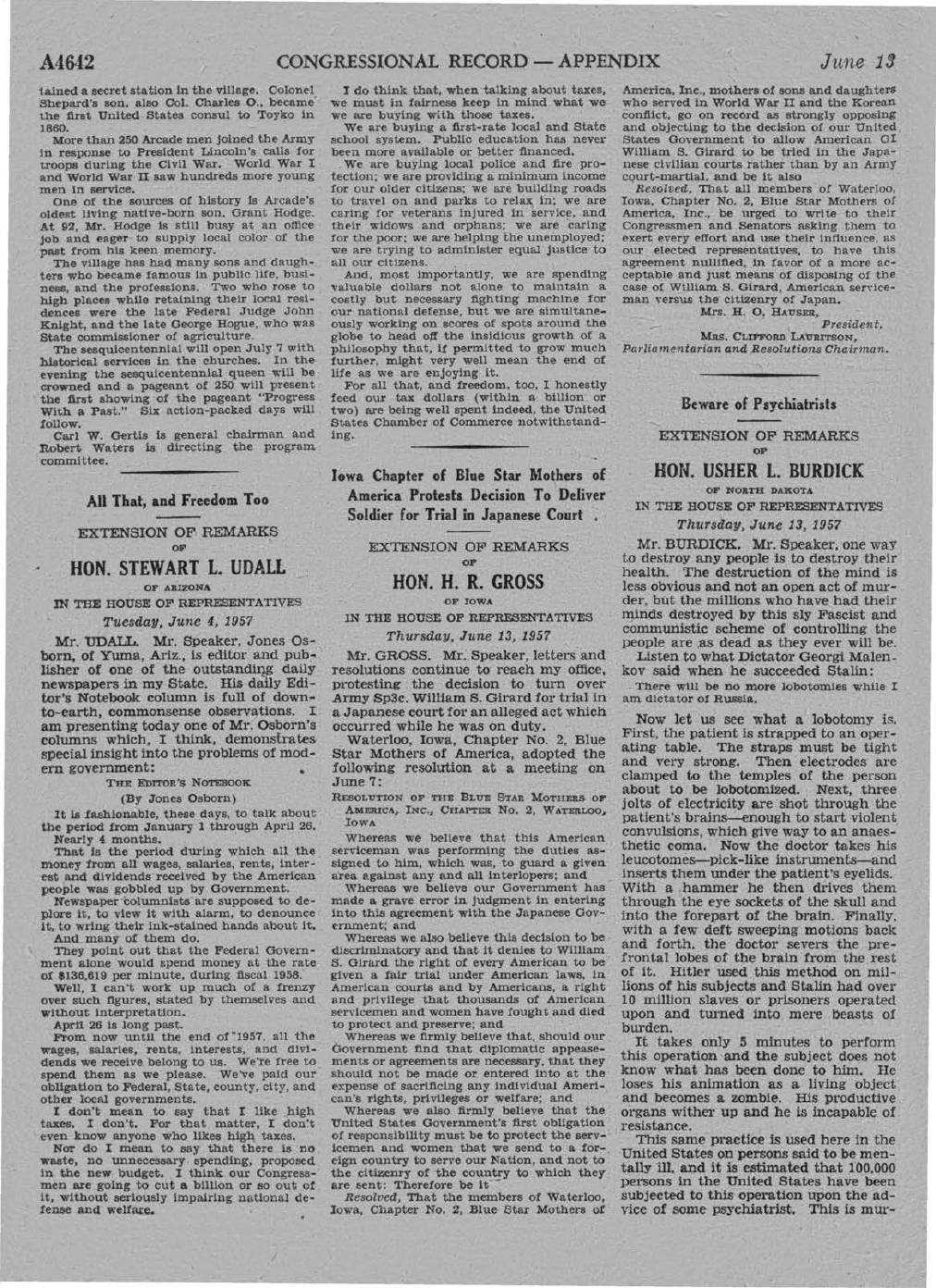
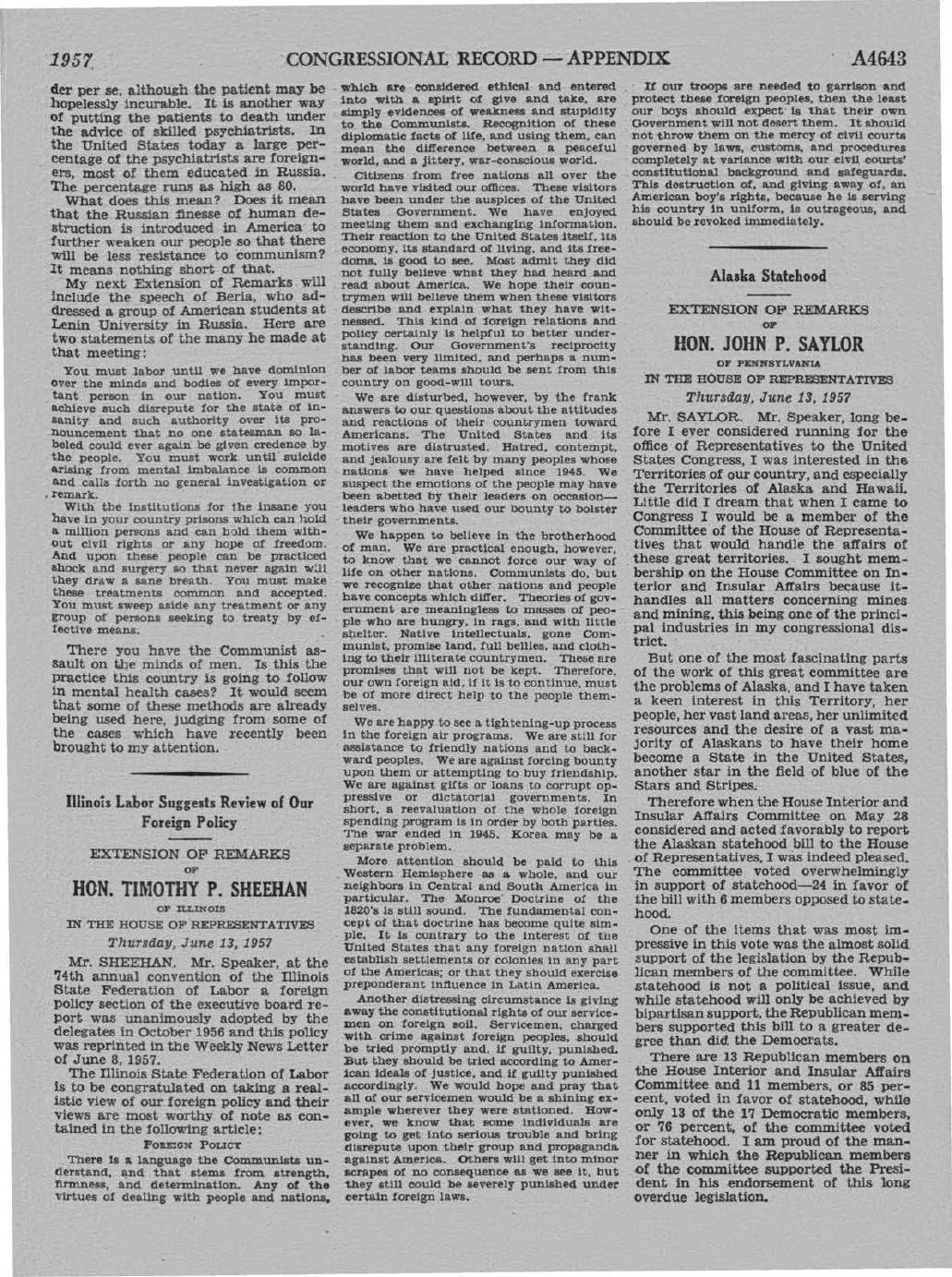
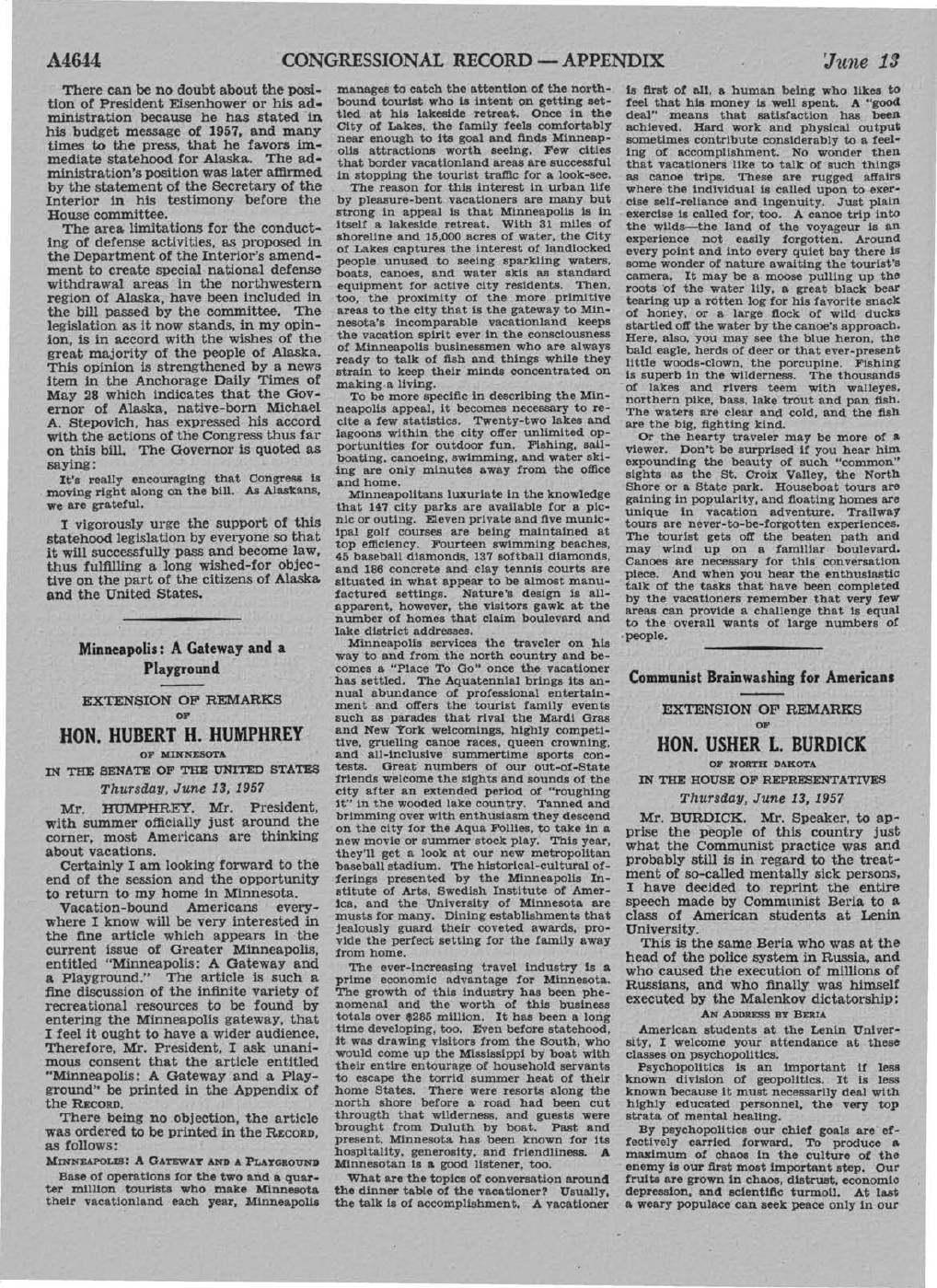
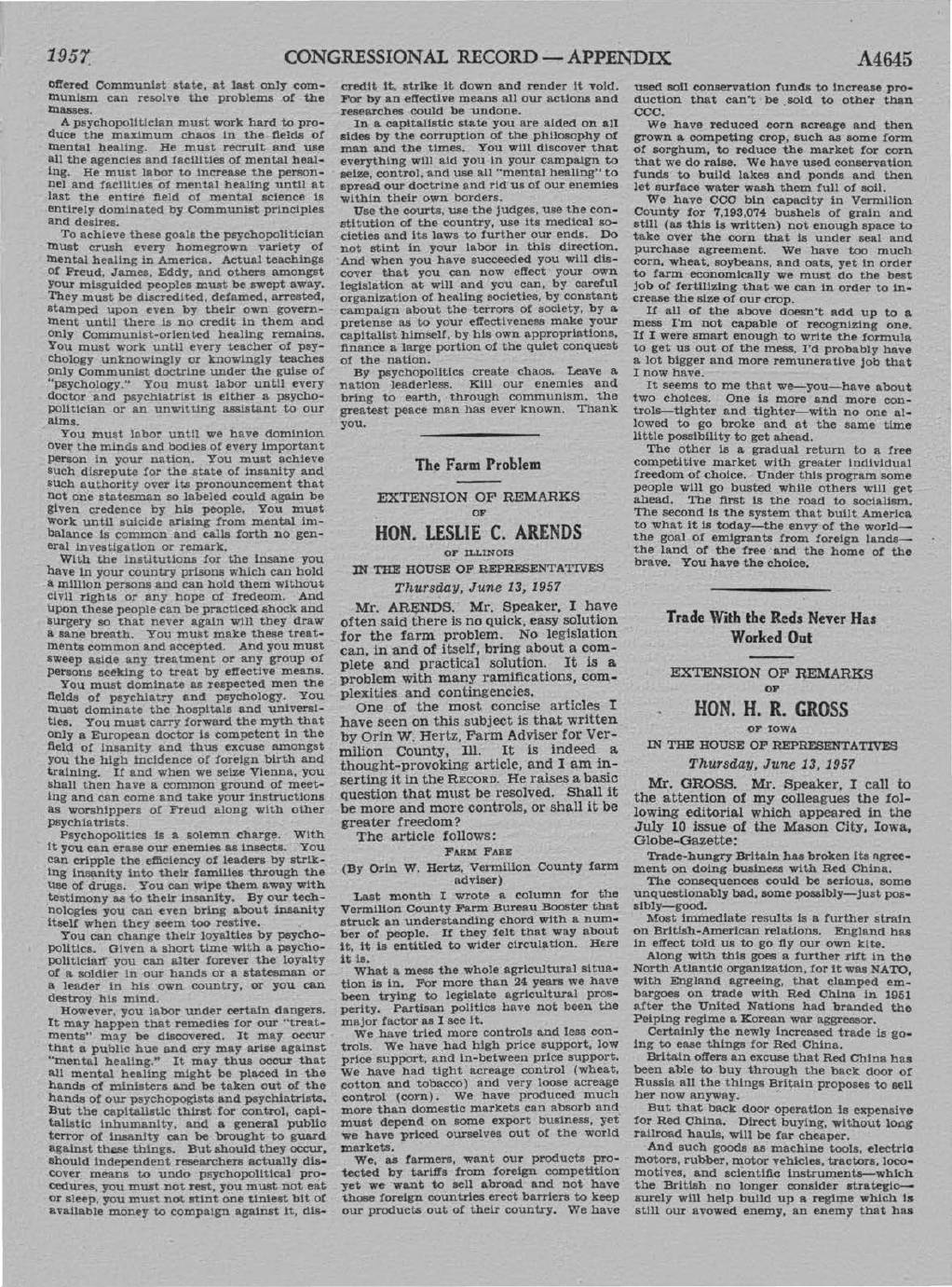
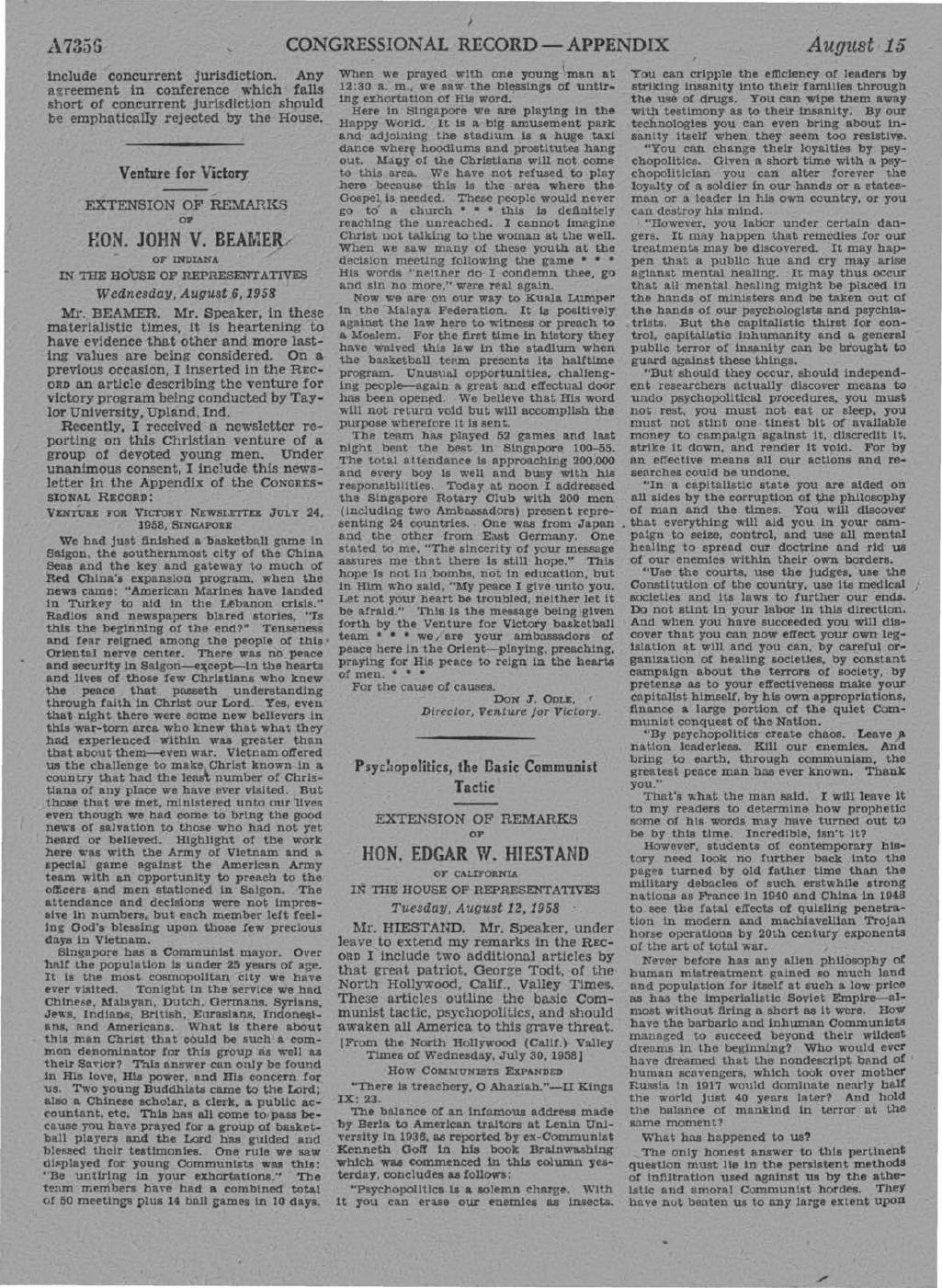
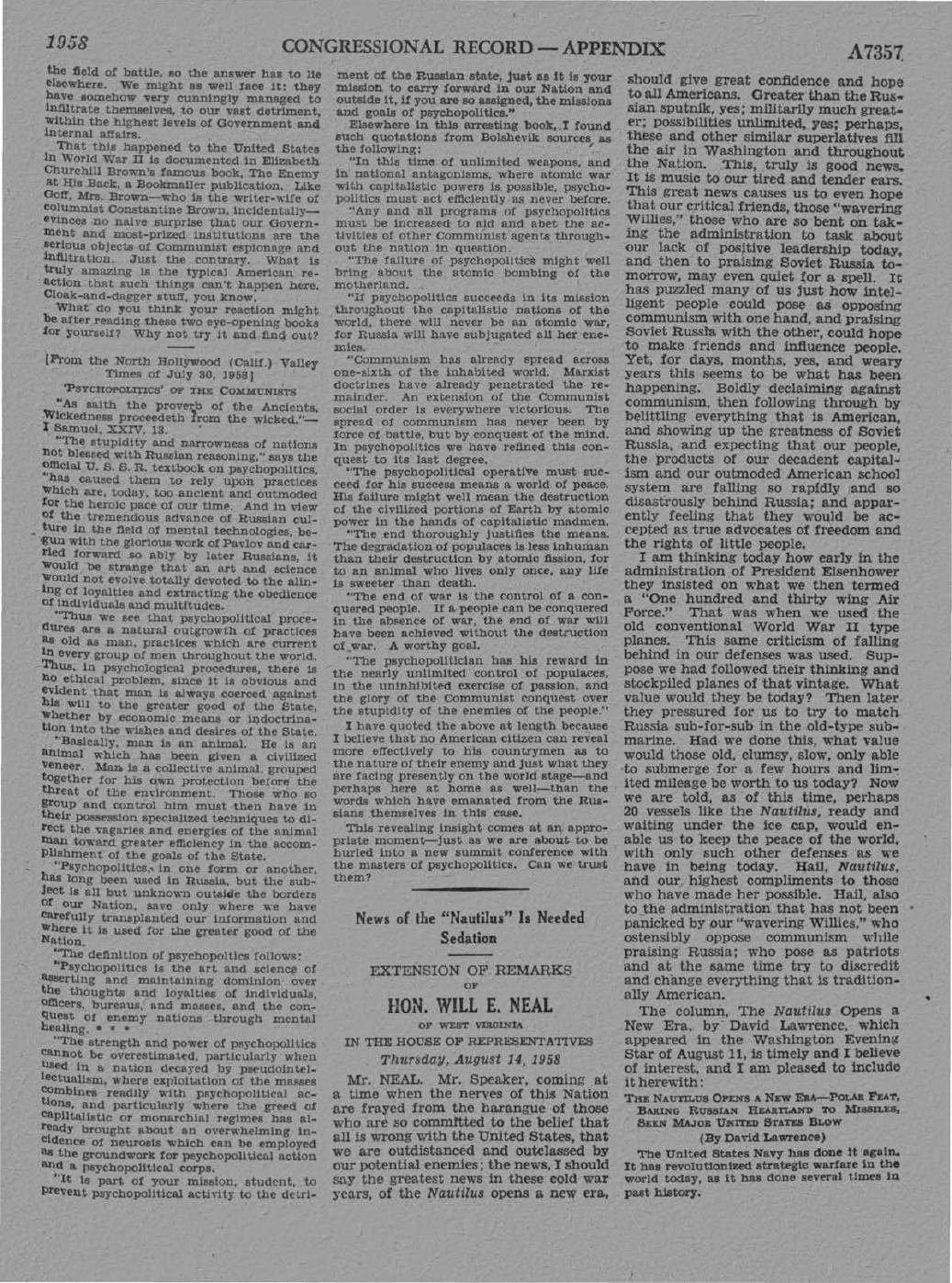
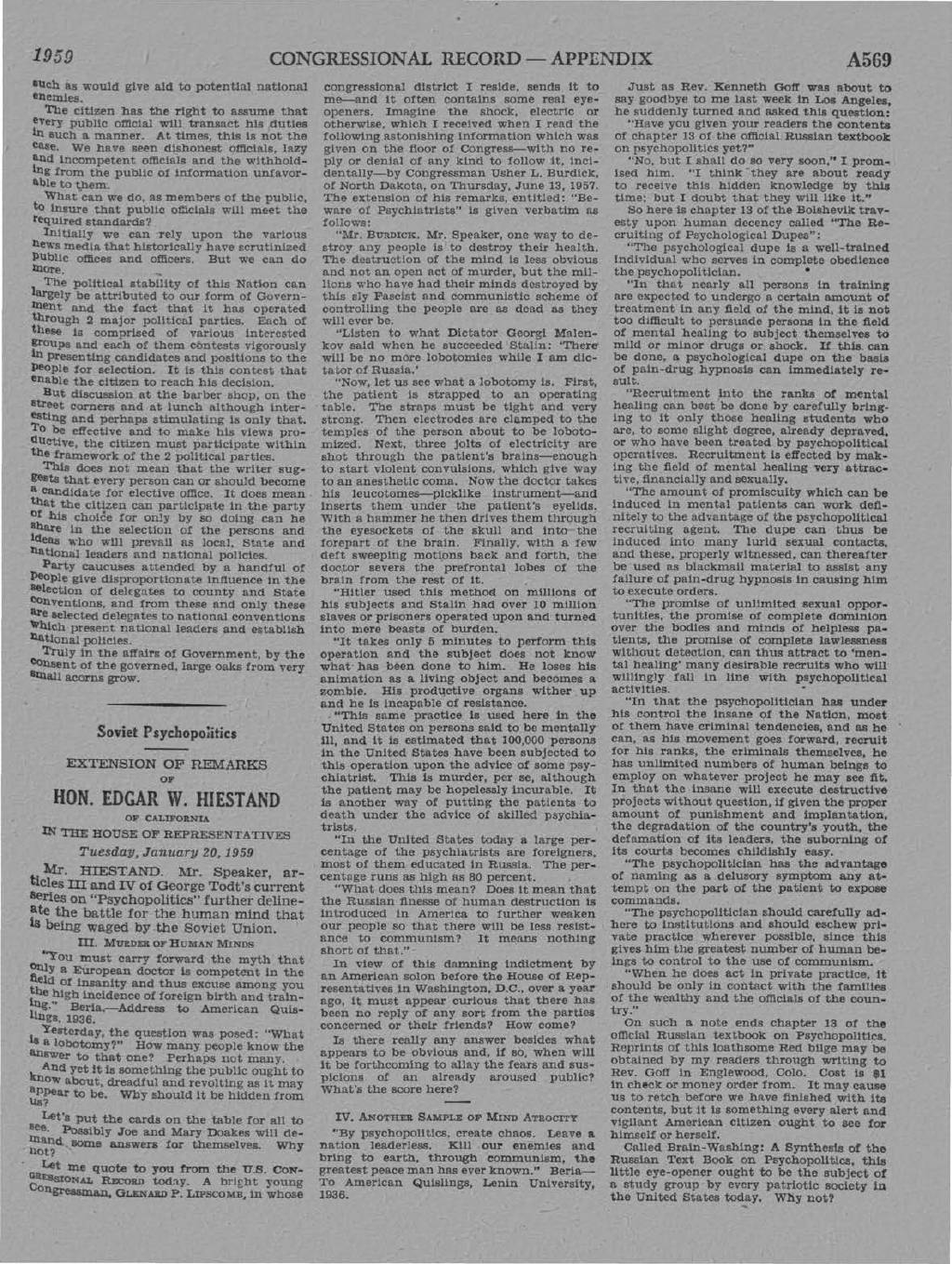
So by January 1959, the Beria address had been printed in full in the Congressional Record, and the booklet itself had been named there by title, along with where to order it.
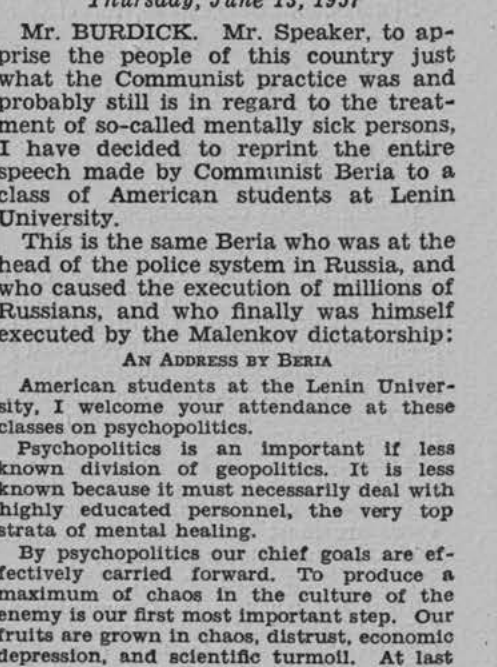 Rep. Burdick introduces the Beria address. 103 Cong. Rec. A4644 (June 13, 1957), bound Appendix. Scan: U.S. Government Publishing Office, govinfo.
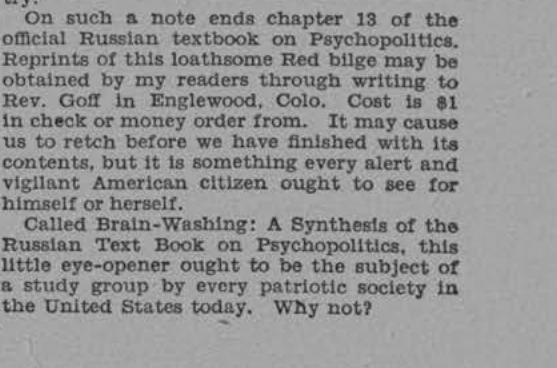 The booklet named by title, with where to get a copy. 105 Cong. Rec. A569 (Jan. 20, 1959), bound Appendix, entered by Rep. Hiestand. Scan: U.S. Government Publishing Office, govinfo.
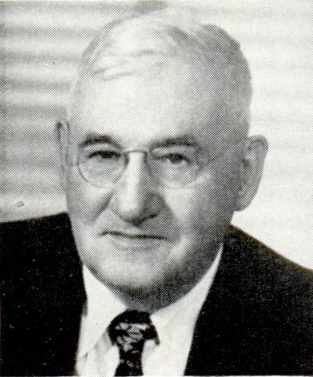 Rep. Usher L. Burdick, from the 1957 Pocket Congressional Directory. U.S. Government work, public domain. Via Wikimedia Commons.

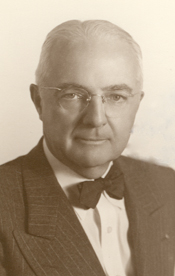 Rep. Edgar W. Hiestand, c. 1953–1963. Courtesy of the Office of the Clerk, U.S. House of Representatives, public domain. Via Wikimedia Commons.

The document
The booklet is called Brain-Washing: A Synthesis of the Russian Textbook on Psychopolitics. It’s free to read and download from the Internet Archive. Every quote below is copied word for word from that scan, with its printed page number, so you can check each one yourself. I’m not paraphrasing anything inside quote marks.
Download the full booklet (PDF, 2.0 MB) — same Internet Archive scan (goff_Brain_washing).
Here’s how it defines its subject:
“PSYCHOPOLITICS: the art and science of asserting and maintaining dominion over the thoughts and loyalties of individuals, officers, bureaus, and masses; and the effecting of the conquest of enemy nations through ‘mental healing.’” (cover/title page)
Conquest through “mental healing.” Keep that phrase in mind. The whole playbook builds toward it.
Here’s the thesis of this post, in the booklet’s own words: the playbook itself identifies Dianetics as effective. It lists “trained Dianeticists” among the people “actually proficient in the handling or treatment of mental health” (p. 45). It names Dianetics among the “actual healing” groups that must be smashed “out of existence” (p. 49). That’s what the document says. You can check it yourself on the pages cited below.
Step 1: Flood the culture with chaos and distrust
The booklet opens with a speech it presents as “An Address by Beria,” given to “American students at the Lenin University.” The first goal it lists isn’t military at all:
“To produce a maximum of chaos in the culture of the enemy is our first most important step. Our fruits are grown in chaos, distrust, economic depression and scientific turmoil. At least a weary populace can seek peace only in our offered Communist State, at last only Communism can resolve the problems of the masses.” (p. 3)
That’s the stated mechanism: wear the population down until the offered system looks like the only way out. The address ends with this summary:
“By psychopolitics create chaos. Leave a nation leaderless. Kill our enemies. And bring to Earth, through Communism, the greatest peace Man has ever known.” (p. 4)
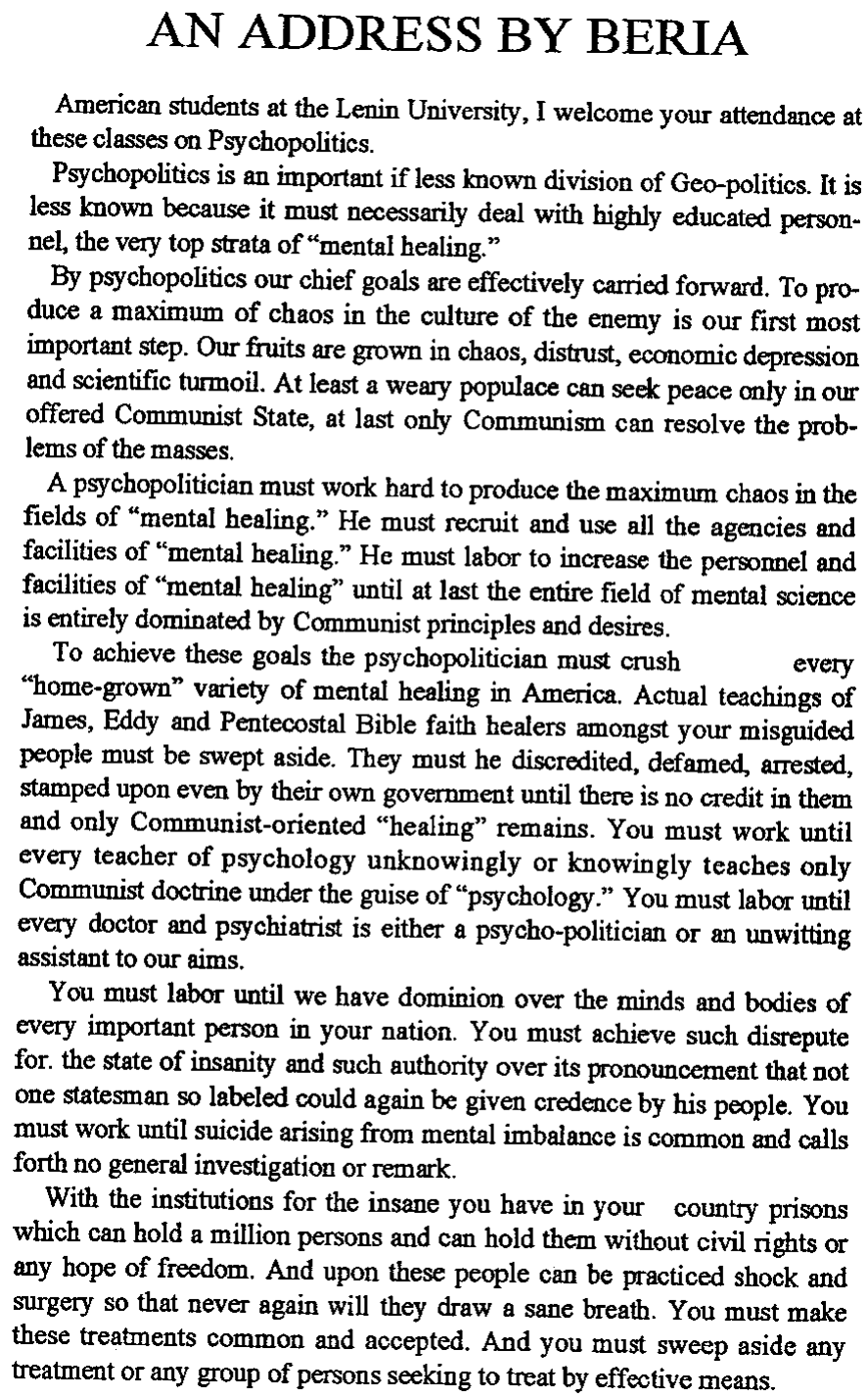 Page 3. Scan: Internet Archive, item goff_Brain_washing.
Step 2: Break the family
Chapter V, “An Examination of Loyalties,” goes through a person’s loyalties one at a time and explains how to destroy each. The second one on its list is family:
“The second loyalty is to his family unit, his parents and brothers and sisters. This is destroyed by making a family unit economically non-dependent, by lessening the value of marriage, by making an easiness of divorce and by raising the children wherever possible by the State.” (p. 26, Chapter V)
The same page spells out what it expects that to produce. Pressure on the home and on children, it says, “…will in the end create the chaos necessary to Communism.” (p. 26)
Step 3: Turn the young
Next come teenagers. The booklet is blunt about the goal:
“If we could effectively kill the national pride and patriotism of just one generation we will have won that country.” (p. 27, Chapter V)
And about the method:
“Creating a greed for drugs, sexual misbehavior and uncontrolled freedom and presenting this to them as a benefit of Communism will with ease bring about our alignment.” (p. 27, Chapter V)
Step 4: Get into the classroom without using the word
Chapter XI, “The Use of Psychopolitics in Spreading Communism,” says the label can come later:
“As the conquest of a nation by Communism depends upon imbuing its population with communistic tenets, it is not necessary that the term, ‘Communism,’ be applied at first to the educative measures employed.” (p. 53, Chapter XI)
It claims the vehicle is psychology textbooks, “to such a degree that anyone thoroughly studying psychology becomes at once a candidate to accept the reasonableness of Communism.” (p. 53)
Step 5: Capture the mental-health system and have the public pay for it
Chapter IX, “The Organization of Mental Health Campaigns,” tells operatives to set up community mental-health groups and use them to press governments for money and facilities:
“…thus bringing a government to finance its own downfall.” (p. 45, Chapter IX)
It also states the scale it hopes for: “a psychiatric ward in every hospital in the land, and psychiatrists in every company and regiment of the nation’s army.” (p. 48)
Step 6: Destroy the healers who actually help
This is where the playbook arrives at its target. The same chapter says the mental-health groups it describes have to purge anyone who’s actually good at the work:
“Mental health organizations must carefully delete from their ranks anyone actually proficient in the handling or treatment of mental health. Thus must be excluded priests, ministers, actually trained psychoanalysts, good hypnotists, or trained Dianeticists.” (p. 45, Chapter IX)
It then describes planting a person inside a target group, “whether Christian Science or Dianetics or faith preachers,” so that the group gets blamed and banned (p. 46). And then it gives the order outright:
"The psychopolitical operative should also spare no expense in smashing out of existence, by whatever means, any actual healing group, such as that of acupuncture, in China, such as Christian Science, Dianetics and faith healing, in the United States; such as Catholicism in Italy and Spain; and the practical psychological groups of England."
(p. 49, Chapter IX)
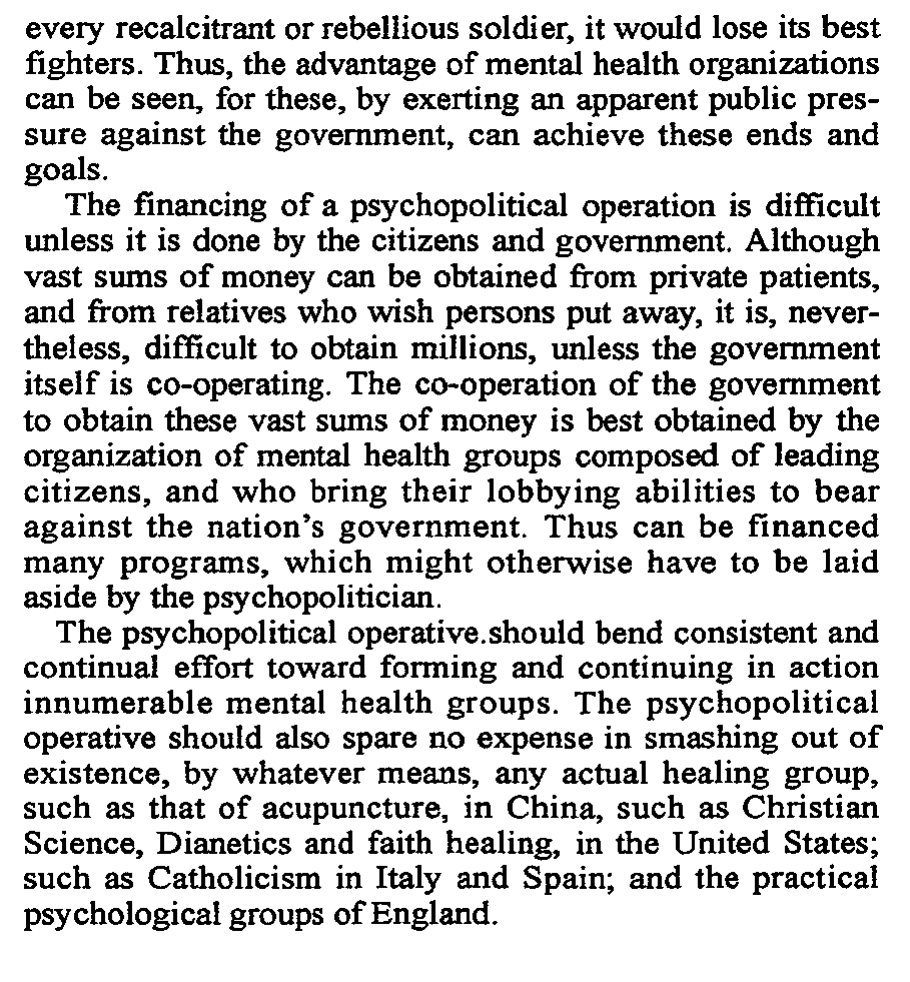 Page 49, Chapter IX. Scan: Internet Archive, item goff_Brain_washing.
Notice the wording: “any actual healing group.” The booklet’s own logic is that the groups that work are the ones that have to go. Put pp. 45 and 49 together and the playbook marks Dianetics twice: its practitioners as “actually proficient” and its movement as an “actual healing group.” That’s the booklet’s own assessment, not mine.
The intended effects, in its own words
Put the steps together and the booklet tells you what it’s aiming for:
- A worn-out population: “a weary populace can seek peace only in our offered Communist State” (p. 3).
- A leaderless nation: “Leave a nation leaderless” (p. 4).
- A generation with no national loyalty: “we will have won that country” (p. 27).
- Communism that looks reasonable: students who become “a candidate to accept the reasonableness of Communism” (p. 53).
- A government paying for it all: “bringing a government to finance its own downfall” (p. 45).
- No real healers left: “smashing out of existence… any actual healing group” (p. 49).
What happened next: the documented record
The National Security Council’s assessment. An evaluator at the Operations Coordinating Board of President Eisenhower’s National Security Council reviewed it on 20 March 1956 and wrote: “if the booklet is a fake, the author or authors know so much about brainwashing techniques that I would consider them experts, superior to any that I have met to date.” (Introvigne, p. 69, citing NSC Papers, OCB File 702.5, Eisenhower Library.)
The Alaska bill. The edition I’m quoting opens with an editorial note that points readers to “the Alaskan Mental Health Bill,” calling it “the attempt to establish a mental Siberia in Alaska” (Editorial Note, front matter). Congress passed the bill anyway. The Alaska Mental Health Enabling Act became Public Law 830 on July 28, 1956 (70 Stat. 709, govinfo).
Into the Congressional Record. From 1957 to 1959, Reps. Burdick and Hiestand put the Beria address, and newspaper columns quoting the booklet, into the Congressional Record. The details and page scans are in “The paper trail” above.
Investigations? I searched for a congressional hearing or federal investigation into psychiatric or mental-health “infiltration” that this booklet prompted. I didn’t find one. The official response I could document is the NSC assessment above.
Meanwhile, in the real labs: LSD and psychiatry. The booklet talks about “striking insanity into their families through the use of drugs” (p. 4) and about “peyote, mescaline, and later drugs which cause temporary insanity” (p. 46). Here’s what the documented record shows about drugs and psychiatry in the same years. It’s a parallel, not proof of any connection.
- The drug: Albert Hofmann at Sandoz in Basel first made lysergic acid diethylamide (LSD-25) in 1938. On April 16, 1943 he felt its effects by accident, and on April 19, 1943 he deliberately took 0.25 mg. Sandoz then made it available “to research institutes and physicians as an experimental drug” under the trade name Delysid. The Delysid prospectus listed “Analytical psychotherapy” among its indications and advised that “By taking Delysid himself, the psychiatrist is able to gain an insight into the world of ideas and sensations of mental patients.” The first systematic human study was run at the University of Zurich’s psychiatric clinic and published in 1947, and Hofmann writes that hallucinogens “gained entry into medicinal research, biology, and psychiatry” (Albert Hofmann, LSD: My Problem Child, 1980, MAPS PDF).
- The CIA: At a joint Senate hearing on August 3, 1977, CIA Director Stansfield Turner testified about 149 MKULTRA subprojects, many connected to “research into behavioral modification, drug acquisition and testing or administering drugs surreptitiously.” The records named 80 institutions, including “44 colleges or universities” and “12 hospitals or clinics.” Senator Kennedy noted that tests included giving LSD to “unwitting subjects in social situations,” and that MKULTRA records had been destroyed in January 1973 on Director Richard Helms’s instructions (Project MKULTRA, the CIA’s Program of Research in Behavioral Modification, Senate Select Committee on Intelligence, 1977).
- The psychiatrist: A federal court later laid out the undisputed funding facts. The CIA set up a front, the Society for the Investigation of Human Ecology, in 1955. A CIA employee who read a 1956 article by Dr. Ewen Cameron of Montreal’s Allan Memorial Institute of Psychiatry invited him to apply for its research funds. Cameron’s application proposed “the use of chemical agents, including LSD, to depattern the individual.” The CIA approved it as MKULTRA Subproject 68, running from March 18, 1957 to June 30, 1960. Whether Cameron’s methods were therapy or experimentation was, in the court’s words, “plainly in dispute” and left for trial (Orlikow v. United States, 682 F. Supp. 77 (D.D.C. 1988)).
Sound familiar?
The booklet tells you what success would look like, and it tells you which healers it feared most. Here are seven of its stated aims next to what U.S. data actually show. These trends have many causes, and nothing here shows that anyone carried out this playbook. Look at the numbers and draw your own conclusions.
1. “Our fruits are grown in chaos, distrust…” (p. 3) In 1958, 73% of Americans said they trust the federal government to do what is right “just about always” or “most of the time.” In September 2025 it was 17% (Pew Research Center, “Public Trust in Government: 1958–2025”).
2. “If we could effectively kill the national pride and patriotism of just one generation we will have won that country.” (p. 27) In 2025, a record-low 58% of U.S. adults said they were “extremely” or “very” proud to be American, down from 91% in 2002. Gallup found Gen Z and millennials “much less proud of their country than their elders” (Gallup, June 30, 2025).
3. “…by lessening the value of marriage…” (p. 26) The U.S. marriage rate fell from 8.2 per 1,000 people in 2000 to 6.1 in 2023 (CDC/NCHS National Vital Statistics System).
4. “…a psychiatric ward in every hospital in the land…” (p. 48) The share of U.S. adults who took an antidepressant in the past 30 days rose from 10.6% in 2009–2010 to 13.8% in 2017–2018 (CDC/NCHS Data Brief No. 377, 2020).
5. “Creating a greed for drugs… will with ease bring about our alignment.” (p. 27)
- Adults overall: In 2025, about 1 in 4 Americans 12 and older (24.0%, or 69.8 million people) used an illicit drug in the past year. SAMHSA’s trend tests for 2021–2025 show past-year illicit drug use increasing overall, driven by adults 26 and older. Past-year hallucinogen use rose from 2.7% (7.6 million) in 2021 to 3.1% (9.1 million) in 2025, and marijuana from 19.0% to 21.2% (61.6 million) (SAMHSA, 2025 NSDUH press release, July 27, 2026; SAMHSA blog, July 27, 2026).
- Psychedelics and cannabis: The NIH-funded Monitoring the Future panel found past-year use of “psychedelic drugs/hallucinogens” reached “the highest levels ever recorded in 2024 among adults ages 19 to 30 and 35 to 50.” Among 35- to 50-year-olds, cannabis use “has doubled or nearly doubled” over the past five and 10 years (University of Michigan ISR, Aug. 26, 2025). In 2025, adult cannabis use stayed “at or near all-time highs,” and daily use among 35- to 50-year-olds rose from 6.6% to 8.5%. Psychedelic use among 19- to 30-year-olds dipped from 8.9% in 2024 to 7.2% in 2025 (NIH, Aug. 12, 2026).
- Microdosing: In a nationally representative RAND survey (Dec. 2023–Jan. 2024), 3.1% of U.S. adults had used psilocybin in the past year, and 46.9% of them said they microdosed the last time they used it. RAND estimates that at least 8.4 million U.S. adults have microdosed psilocybin (RAND; RAND press release, June 27, 2024).
- Teens go the other way: Past-year illicit drug use among 12- to 17-year-olds decreased from 2021 to 2025 (NSDUH). In 2024, a record 67.1% of high school seniors said they hadn’t used marijuana, alcohol, or nicotine in the past 30 days (NIDA, Dec. 17, 2024).
6. “By psychopolitics create chaos.” (p. 4) In 2016, Russia’s Internet Research Agency (IRA) ran fake American social media accounts on both sides of the divide. The Mueller report says the IRA’s goal was “sowing discord in the U.S. political system.” It ran fake conservative groups like “Being Patriotic” and “Secured Borders” alongside fake Black social justice groups like “Blacktivist” and “Black Matters” (Mueller report, Vol. I, Sec. II, pp. 14, 24–25). The Senate Intelligence Committee found that the operatives used “hot-button, societal divisions” to “pit Americans against one another and against their government” (SSCI report, Vol. 2, p. 6). After the election they worked both sides on the same day. On or about November 12, 2016, one IRA-controlled group organized a New York rally to “show your support for President-Elect Donald Trump,” and another IRA-controlled group organized a New York rally called “Trump is NOT my President” (Special Counsel indictment, U.S. v. Internet Research Agency, ¶ 57; SSCI Vol. 2, p. 42). 7. “He can instruct, in an optimum situation, the entire nation in how to handle children…” (p. 27) The same page that targets the young says the operative, “from his position as an authority on the mind,” can “advise all manner of destructive measures” and “instruct, in an optimum situation, the entire nation in how to handle children” (p. 27). Here’s what official data show about psychiatric drugs and American kids:
- ADHD diagnoses and medication: In 2022, 11.4% of U.S. children ages 3–17 (about 7.1 million) had ever been diagnosed with ADHD, about 1 million more than in 2016. Of the 10.5% (6.5 million) with current ADHD, 53.6% were taking ADHD medication (CDC, ADHD Data and Statistics; Danielson et al., J. Clin. Child & Adolesc. Psychol., 2024).
- Stimulants: Among commercially insured Americans ages 5–64, the share filling a stimulant prescription rose from 3.6% in 2016 to 4.1% in 2021. For girls 15–19 it went from 5.3% to 6.1%, including a 15.1% jump from 2020 to 2021 alone. Boys 10–14 had the highest rate of any group, at 10.8% in 2016 and 9.9% in 2021 (CDC, MMWR, March 31, 2023). On August 1, 2023, the DEA and FDA warned of stimulant shortages “in combination with record-high prescription rates of stimulant medications,” noting that “from 2012 to 2021, overall dispensing of stimulants… increased by 45.5 percent” (DEA/FDA joint letter).
- Antidepressants: From January 2016 to December 2022, the monthly rate of antidepressant dispensing to Americans ages 12–25 rose 66.3%, from 2,575.9 to 4,284.8 per 100,000. After March 2020 it rose 63.5% faster than before, and 129.6% faster among girls 12–17. Dispensing to boys 12–17 dropped at the outbreak instead (Chua et al., Pediatrics, 2024).
- The pushback, written into law: In 2003 the U.S. House passed the Child Medication Safety Act 425–1 “to protect children and their parents from being coerced into administering psychotropic medication in order to attend school” (H.R. 1170; H. Rept. 108-121). It passed the House again in 2005, 407–12 (H.R. 1790; Roll Call 590). Neither bill passed the Senate. The protection itself became federal law in the 2004 rewrite of the Individuals with Disabilities Education Act, which requires states to “prohibit State and local educational agency personnel from requiring a child to obtain a prescription for a substance covered by the Controlled Substances Act… as a condition of attending school” (20 U.S.C. § 1412(a)(25)). Many states have added their own versions. Connecticut requires every school board to bar staff from “recommending the use of psychotropic drugs for any child” (Conn. Gen. Stat. § 10-212b). Texas bars school employees from recommending a psychotropic drug or using a parent’s refusal “as grounds, by itself, for prohibiting the child from attending a class” (Tex. Educ. Code § 38.016). Oregon bars school personnel from requiring a controlled-substance prescription “as a condition of attending school” (ORS 339.873). The Citizens Commission on Human Rights (CCHR) says it “spearheaded a national campaign” that led to the federal amendment, and that its “work with state legislators” led to similar protections in 11 states (CCHR, Fight for Kids).
Some trends line up with the booklet’s goals and some go the other way. A checklist isn’t a cause. But go back to the one thing the playbook says plainly about its rivals. Out of every school of mental healing it could have named, it singled out Dianetics twice, as “actually proficient” (p. 45) and as an “actual healing group” to be smashed “out of existence” (p. 49). By the playbook’s own account, it saw Dianetics as effective. The full booklet is a free download. Pull the raw frames yourself, same as I would with camera footage: no filter, nobody’s summary.
Conspiracy theorists, rejoice. Then read it. 📚
Sources
- Brain-Washing: A Synthesis of the Russian Textbook on Psychopolitics. Undated AFN Books reprint (Johnstown, CO), with an editorial note signed by Kenneth Goff. Local download: /assets/docs/brain-washing-psychopolitics.pdf (2.0 MB). Source scan: Internet Archive https://archive.org/details/goff_Brain_washing (PDF: https://archive.org/download/goff_Brain_washing/goff_Brain_washing.pdf). Quotes use the printed page numbers.
- Massimo Introvigne, “Did L. Ron Hubbard Believe in Brainwashing? The Strange Story of the ‘Brain-Washing Manual’ of 1955,” Nova Religio 20, no. 4 (2017): 62–79, https://doi.org/10.1525/nr.2017.20.4.62. Cited here only for the documented NSC assessment.
- Alaska Mental Health Enabling Act, Pub. L. 84-830, 70 Stat. 709 (July 28, 1956): https://www.govinfo.gov/content/pkg/STATUTE-70/pdf/STATUTE-70-Pg709.pdf
- Congressional Record (bound edition), Appendix, U.S. Government Publishing Office via govinfo: Rep. Usher L. Burdick, “Beware of Psychiatrists” and “Communist Brainwashing for Americans,” 103 Cong. Rec. A4642–A4645 (June 13, 1957), https://www.govinfo.gov/app/details/GPO-CRECB-1957-pt20/GPO-CRECB-1957-pt20-1 (vol. 103, pt. 20; page scans: A4642, A4643, A4644, A4645); Rep. Edgar W. Hiestand, “Psychopolitics, the Basic Communist Tactic,” 104 Cong. Rec. A7356–A7357 (Aug. 12, 1958), https://www.govinfo.gov/app/details/GPO-CRECB-1958-pt25/GPO-CRECB-1958-pt25-1 (vol. 104, pt. 25; page scans: A7356, A7357); Rep. Edgar W. Hiestand, “Soviet Psychopolitics,” 105 Cong. Rec. A569 (Jan. 20, 1959), https://www.govinfo.gov/app/details/GPO-CRECB-1959-pt18/GPO-CRECB-1959-pt18-1 (vol. 105, pt. 18; page scan: A569). Index volumes 103 and 104 list further Hiestand/Todt entries at A7286–87 and A7576–77 (1958).
- Pew Research Center, “Public Trust in Government: 1958–2025” (updated Dec. 4, 2025): https://www.pewresearch.org/politics/2024/06/24/public-trust-in-government-1958-2024/
- Gallup, “American Pride Slips to New Low” (June 30, 2025): https://news.gallup.com/poll/692150/american-pride-slips-new-low.aspx
- CDC/NCHS, “Provisional number and rates of marriages, divorces, and annulments: United States, 2000–2023”: https://www.cdc.gov/nchs/data/dvs/marriage-divorce/national-marriage-divorce-rates-00-23.pdf
- Brody DJ, Gu Q., “Antidepressant Use Among Adults: United States, 2015–2018,” NCHS Data Brief No. 377 (2020): https://www.cdc.gov/nchs/products/databriefs/db377.htm
- NIDA, “Reported use of most drugs among adolescents remained low in 2024” (Dec. 17, 2024): https://nida.nih.gov/news-events/news-releases/2024/12/reported-use-of-most-drugs-among-adolescents-remained-low-in-2024 ; University of Michigan news release (Dec. 17, 2024): https://news.umich.edu/missing-rebound-youth-drug-use-defies-expectations-continues-historic-decline/
- SAMHSA, “SAMHSA Releases Annual National Survey on Drug Use and Health” (July 27, 2026): https://www.samhsa.gov/newsroom/press-announcements/20260727/samhsa-releases-annual-national-survey-on-drug-use-and-health ; SAMHSA blog, “Release of the 2025 National Survey on Drug Use and Health” (July 27, 2026): https://www.samhsa.gov/blog/release-2025-nsduh-using-data-to-drive-great-american-recovery
- University of Michigan Institute for Social Research, “Nicotine pouch, cannabis, vaping, psychedelic use on the rise among US adults” (Aug. 26, 2025, MTF Panel 2024 data): https://isr.umich.edu/news-events/news-releases/nicotine-pouch-cannabis-vaping-psychedelic-use-on-the-rise-among-us-adults-2/ ; NIH, “Elevated use of cannabis, nicotine among U.S. adults continues into 2025” (Aug. 12, 2026): https://www.nih.gov/news-events/news-releases/elevated-use-cannabis-nicotine-among-us-adults-continues-into-2025
- RAND, “Psilocybin Microdosing in the United States: Insights from a Nationally Representative Survey”: https://www.rand.org/pubs/external_publications/EP71229.html ; RAND press release (June 27, 2024): https://www.rand.org/news/press/2024/06/27.html
- Albert Hofmann, LSD: My Problem Child (McGraw-Hill, 1980), MAPS edition: https://maps.org/images/pdf/books/lsdmyproblemchild.pdf
- Project MKULTRA, the CIA’s Program of Research in Behavioral Modification, Joint Hearing, Senate Select Committee on Intelligence and Subcommittee on Health and Scientific Research, 95th Cong. (Aug. 3, 1977): https://www.intelligence.senate.gov/wp-content/uploads/2024/08/sites-default-files-hearings-95mkultra.pdf
- Orlikow v. United States, 682 F. Supp. 77 (D.D.C. 1988): https://hallapproved.com/dc/cases/federal/district/1988/1583126/
- Robert S. Mueller III, Report On The Investigation Into Russian Interference In The 2016 Presidential Election, Vol. I, Section II, “Russian ‘Active Measures’ Social Media Campaign,” pp. 14, 24–25 (U.S. Department of Justice, March 2019): https://www.justice.gov/archives/sco/file/1373816/dl
- U.S. Senate Select Committee on Intelligence, Report on Russian Active Measures Campaigns and Interference in the 2016 U.S. Election, Volume 2: Russia’s Use of Social Media with Additional Views (Oct. 2019), pp. 6, 42: https://www.intelligence.senate.gov/sites/default/files/documents/Report_Volume2.pdf
- Indictment, United States v. Internet Research Agency LLC, et al., No. 1:18-cr-00032-DLF (D.D.C. Feb. 16, 2018), ¶ 57, p. 23: https://www.justice.gov/archives/sco/file/1035477/dl
- Danielson ML, Claussen AH, Bitsko RH, et al., “ADHD Prevalence Among U.S. Children and Adolescents in 2022: Diagnosis, Severity, Co-Occurring Disorders, and Treatment,” Journal of Clinical Child & Adolescent Psychology (2024): https://doi.org/10.1080/15374416.2024.2335625 ; CDC, “Data and Statistics on ADHD”: https://www.cdc.gov/adhd/data/index.html
- Danielson ML, Bohm MK, Newsome K, et al., “Trends in Stimulant Prescription Fills Among Commercially Insured Children and Adults — United States, 2016–2021,” MMWR 72, no. 13 (March 31, 2023): 327–332, https://www.cdc.gov/mmwr/volumes/72/wr/mm7213a1.htm
- DEA and FDA, joint letter to the public on prescription stimulant shortages (Aug. 1, 2023): https://www.dea.gov/documents/2023/2023-08/2023-08-01/dea-and-fda-issue-joint-letter-public-actions-address-shortages (PDF: https://www.fda.gov/media/170736/download)
- Chua KP, et al., “Antidepressant Dispensing to US Adolescents and Young Adults: 2016–2022,” Pediatrics 153, no. 3 (2024): e2023064245, https://publications.aap.org/pediatrics/article/153/3/e2023064245/196655/Antidepressant-Dispensing-to-US-Adolescents-and
- Child Medication Safety Act of 2003, H.R. 1170, 108th Cong. (passed House May 21, 2003, 425–1, Roll Call 203): https://www.congress.gov/bill/108th-congress/house-bill/1170 ; H. Rept. 108-121: https://www.govinfo.gov/content/pkg/CRPT-108hrpt121/html/CRPT-108hrpt121.htm ; Child Medication Safety Act of 2005, H.R. 1790, 109th Cong. (passed House Nov. 16, 2005, 407–12, Roll Call 590): https://www.congress.gov/bill/109th-congress/house-bill/1790 , https://clerk.house.gov/Votes/2005590 ; Individuals with Disabilities Education Improvement Act of 2004, Pub. L. 108-446, § 101, codified at 20 U.S.C. § 1412(a)(25), “Prohibition on mandatory medication”: https://www.law.cornell.edu/uscode/text/20/1412
- State statutes: Conn. Gen. Stat. § 10-212b, https://www.cga.ct.gov/current/pub/chap_169.htm ; Tex. Educ. Code § 38.016, https://statutes.capitol.texas.gov/Docs/ED/htm/ED.38.htm ; Or. Rev. Stat. § 339.873, https://oregon.public.law/statutes/ors_339.873
- CCHR International, “Fight For Kids—CCHR’s Campaign to Protect Children”: https://www.cchrint.org/fightforkids-accomplishments/